
I’ve struggled with the decision whether to post this or not. As you can see, I have. I’ve written it in the most appropriate way possible – but as you’ll discover, there’s some upsetting descriptions.
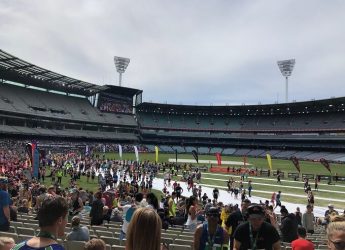
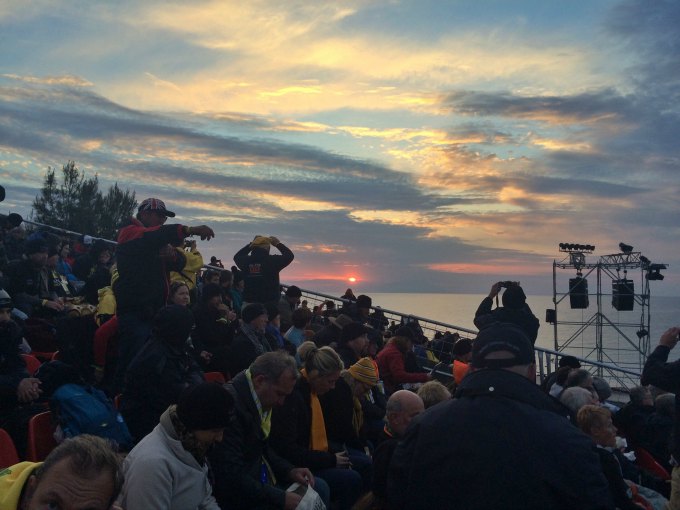
Attendance at an Anzac Day dawn service at Gallipoli is a vigil. As a participant, you’re well aware of this as you sit or stand at the commemorative site, eyes bleary, shivering under sleeping bags and blankets. Even so, the crowd still receives the occasional reminder over the PA system (“It’s not supposed to be easy.”) This period of observation was eye-opening, but not for the reasons I had expected.
In the very early hours of the twenty-fifth, on a trip to the toilet, I passed a couple arguing because the female partner had opted out of the slow and snaking hot food line to buy a cheese sandwich roll. “What good is this?” the male repeated, shaking the bread in her face after she’d handed it over. “What bloody good?”
After the dawn service concluded and the corralled masses waited to be released to head up to Lone Pine, a man grabbed the arm of a woman, leaned close to her face and hissed, “How dare you, don’t ever disrespect me like that again. I won’t have it.”
It was impossible not to overhear as we were all crushed together on the gently sloping grass. Alarmed, I looked across, as did several other people. The woman stood silent, eyes cast to the ground, before managing a slight nod, admitting fault. Argument concluded – or postponed – the man returned to her side to wait. The crowd absorbed the hostility, perhaps disarmed it somewhat, but we did nothing to help.
I came to the 100th anniversary of the Gallipoli landings to pay respects – my great-grandfather fought there – but also to come to an understanding of the undeniable hardship and how this has grown into the ANZAC myth, built on strength, loyalty and mateship.
There was evidence of that, no doubt. A man sitting in the row in front brought nothing but a thick hoodie as coverage for the long night. Aghast, another man, a stranger, unzipped his backpack and handed over a folded silver package; a space blanket, the packet read.
“Nah, mate, nah,” said the receiver, trying to pass it back. “I’ll be right. You keep it.”
“It’s fine, it’s my spare. You’ll need it.”
The first man eventually accepted and by morning had it wrapped tight around his shoulders.
But more disappointments were still to come.
Late in the afternoon, after all formalities had concluded and the long wait for buses to leave the peninsula began, more announcements came over the loudspeakers: Please be patient with one another; please do not lie on the graves or rest on the headstones; please do not disrespect the monument by sleeping on it.
Many people in repose on the memorial stood up, heeding the request. Others remained still, even after more prompting, with their hats pulled well down over their brows.
A sudden voice rang out from the stands, over the thousands of people. “Hey! Get up! Didn’t you hear them? You’re being disrespectful to the dead.” This woman’s outrage brought scattered applause, allowing others the courage to add their own comments of disapproval.
When I asked for a comment from the Department of Veterans’ Affairs (DVA), I got the reply that this kind of behaviour is not without precedent on Anzac Day. And here I am, six months later, still thinking about contrasting behaviours by certain individuals, a kind of homage-slash-rebellion. What of empathy? I found it in an elderly Turkish stall owner in Istanbul. Upon hearing we were Australian, he remarked, “Turks and Australians – we are good friends. Your grandfathers and great-grandfathers are sleeping in our soil. Bonded.”
I found it again in another kind of long, dark vigil – this time our flight home from Dubai. Those of us unable to sleep gathered in the food galley to snack and compare Anzac Day stories. I pointed to the black eye of one of the chattier blokes, the bruise spread halfway down his late-middle-aged cheek. “What’s that from?”
“I pulled apart a fight between an Australian and a New Zealander in Çanakkale and came off second best. It was late, everyone was back on the drink. It had been a long couple of days.”
“I’m sorry that happened.”
He took a sip of soft drink and lifted his shoulder, a gesture of both humility for his part and thanks for the remark. “Me too. Bit of a disgrace, really.”
Remembrance Day celebrates the sacrifices made by our nation’s men and women in times of war and armed conflict. I respect this and commend our service men and women, saying as much to Riley as I pinned a badge on to his school uniform this morning. But after this year, I will also use the occasion to pause and reflect. I do not want to be fixated on the past at the expense of the present and its responsibilities.